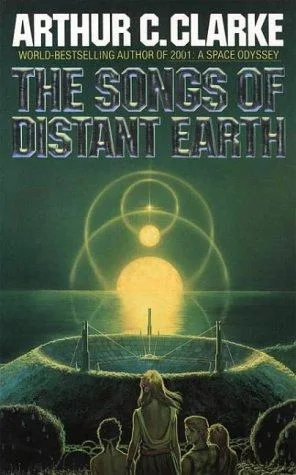
The Songs of Distant Earth (1986)
The Songs of Distant Earth is a 1986 english science fiction book written by Arthur C. Clarke.
Thalassa is close to a paradise: a warm ocean world settled centuries ago by robot seedships, its scattered islands home to people who have never known war or want. Then the Magellan arrives, a starship carrying the last refugees of an Earth consumed when the sun went nova, pausing in orbit to rebuild its ice shield before the long voyage onward. Arthur C. Clarke, who named this his favorite among his own novels, writes a quiet, humane story about two cultures meeting: one that lost everything, and one that never had to.
Similar books
Explore The Songs of Distant Earth guides
The Songs of Distant Earth in our writing
- Companion guide: Generation Ships
A few thoughts on The Songs of Distant Earth
For the same ache of humanity carrying its heritage away from a dying Earth, Interstellar lands in an identical register, patient and awed rather than loud. Silo shares the mood of a small remnant preserving what it can of a vanished world. Mike Oldfield built an entire ambient album around this novel, an ideal listening companion.
Starships carrying the last of humanity toward a new home
The Magellan carries Earth's last refugees to Thalassa after the sun goes nova, one small ember of humanity searching for a new home. Interstellar sends explorers through a wormhole for the same reason, Project Hail Mary follows a lone crewman racing to save Earth from a different cosmic threat, and Old Man's War, Mass Effect and Stargate SG-1 all imagine humanity pushing outward into the stars to survive.
Manga that treats deep space and deep time with quiet wonder
Clarke wrote Thalassa as an unhurried meeting of two human futures, and these manga share that same cosmic patience. Galaxy Express 999 sends a boy across the stars chasing immortality on a space train, Phoenix follows life and death across thousands of years, Space Brothers grounds that wonder in the ordinary work of becoming an astronaut, and Ghost in the Shell asks what a self is once technology outpaces biology.
Concept albums that imagine a whole future for humanity in space
Arthur C. Clarke considered this his own favorite among his novels, and Mike Oldfield loved it enough to build a whole 1994 album around it, inspired by and named for this same story. Ayreon's Flight of the Migrator tells its own interstellar saga through prog-metal, Deltron 3030 raps its way through a hip-hop future centuries out, and Muse's Simulation Theory turns cosmic and simulated futures into arena-sized synth rock.