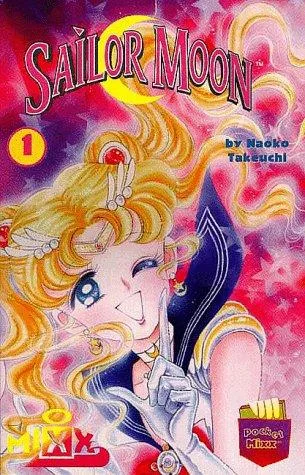
Sailor Moon (1991)
Sailor Moon is a 1991 magical girl title by Naoko Takeuchi.
Usagi Tsukino oversleeps, flunks her tests, cries in public and eats too much cake. She is also the one thing standing between Tokyo and the end of the solar system.
Naoko Takeuchi serialized the series in Kodansha's shojo magazine Nakayoshi from 1991 to 1997: sixty chapters plus side stories, later collected into eighteen tankobon volumes. It starts small and domestic, a 1990s Tokyo of school uniforms, arcades and crushes, where a schoolgirl transforms and goes hunting for a magical artifact called the Legendary Silver Crystal. She ends up leading a group of comrades, the Sailor Soldiers, renamed the Sailor Guardians in later editions, against villains who want the crystal for themselves.
The art is shojo at its most confident: long limbs, huge eyes, panel borders that dissolve into ribbon and starlight the moment a fight begins. The comedy is broad, the romance is sincere, and Takeuchi lets a failed math quiz sit in the same chapter as the fate of the planets without either one looking silly.
Sixty chapters is not much room, so the plot moves. If your only Sailor Moon is the anime, the manga is the compressed version, quicker to escalate, with Takeuchi's own linework carrying the weight. Read it if you want magical-girl storytelling at the source, or if you have a soft spot for a heroine who saves everything and still cannot get her homework in on time.
Official site
Similar titles
Explore Sailor Moon guides
Sailor Moon in our writing
- Companion guide: Magical Girl: The Complete Guide to Mahou Shoujo
A few thoughts on Sailor Moon
The closest living relative is Miraculous: Tales of Ladybug & Cat Noir, which runs the same engine: a clumsy schoolgirl, a secret transformation, a monster to beat each week, and a love life tangled up in both identities. For the other half of the appeal, the ordinary teenager guarding a secret, Smallville spends ten seasons on exactly that problem, with a farm instead of a Tokyo arcade. Harry Potter and the Philosopher's Stone delivers the same first thrill of an unremarkable kid told they were always the chosen one, plus a school and a found family to grow into. For atmosphere, put on もののけ姫 サウンドトラック, the Princess Mononoke score: 1990s Japanese fantasy in sound, girls and gods and a planet worth protecting, taken as seriously as Takeuchi takes her own cosmology.