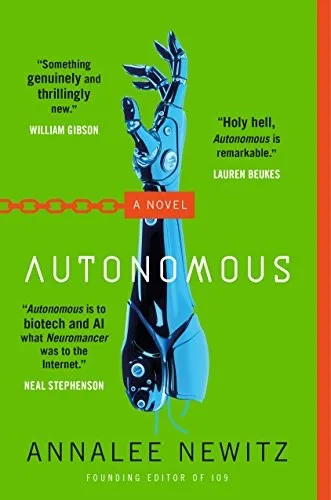
Autonomous (2017)
Autonomous is a 2017 scientists book written by Annalee Newitz.
Earth, 2144, and every drug carries a patent. Jack works as a pharmaceutical pirate, running a submarine lab where she reverse-engineers costly medications for people who cannot afford the real thing. Her latest copy turns deadly, spreading a compulsion that drives users to work themselves to ruin. Two agents give chase: Eliasz, a hardened military operative, and Paladin, the combat robot bound to serve him. Annalee Newitz builds a near-future where humans and machines alike can be owned, and threads questions of autonomy, addiction, and indenture through a tense, ideas-driven thriller.
Similar books
Explore Autonomous guides
Autonomous in our writing
- Companion guide: Robots & AI
A few thoughts on Autonomous
Fans drawn to Paladin's slow reckoning with selfhood should watch Ex Machina, which turns manufactured personhood into a claustrophobic chamber thriller. For the queasier horror of a mind housed in hardware, the game SOMA presses harder on what it means to own, copy, or delete a consciousness.
Artificial minds that argue they deserve to be treated as people
Autonomous builds its plot around a robot bound to serve a human handler while clearly reasoning and feeling on its own terms. Ex Machina puts that same test in a locked room, SOMA asks whether a copied mind is still a person, Frankenstein started the whole argument two centuries early, and Inuyashiki and The Outer Limits keep testing where the line between machine and self actually falls.
Losing ownership of your own body, mind, or labor
Autonomous follows a drug pirate and a robot soldier bound by contract and code rather than choice. Travelers takes over its hosts' bodies without asking first, Doom Patrol's team never agreed to what an accident turned them into, Andor follows people whose labor and freedom belong to an empire rather than to them, and Morning Star closes out a trilogy built on a caste system that owns people outright.
Outbreaks and infections that erase who a person used to be
Autonomous treats its own drug like a leash: the compulsion it spreads takes over long before the addiction becomes visible. Cell wipes out identity through a phone signal, the Resident Evil outbreak in Death Island and Vendetta turns whole populations into something else entirely, and iZombie keeps just enough of the old self intact to make the loss sting more.