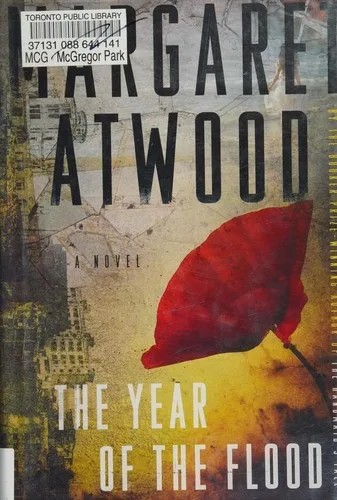
The Year of the Flood (2009)
The Year of the Flood is a 2009 fiction book written by Margaret Atwood.
The waterless flood has come, a pandemic bred from humanity's own hubris, and most of the world is gone. In the wreckage two women hold on. Toby rode it out barricaded inside the AnooYoo spa; Ren survived locked in the sealed dressing room of a sex club called Scales and Tails. Both once belonged to God's Gardeners, a green cult led by the gentle, apocalypse-minded Adam One. Margaret Atwood braids their pasts and present through hymns, sermons, and memory, rebuilding a corporate-ruled America of gene-spliced animals and gated compounds. It runs alongside Oryx and Crake, the same collapse seen from the ground floor.
Similar books
Explore The Year of the Flood guides
The Year of the Flood in our writing
- Companion guide: Biopunk
- Companion guide: Climate Fiction
- Companion guide: Genetic Engineering & Designer Humans
- Companion guide: Pandemic & Outbreak
A few thoughts on The Year of the Flood
Station Eleven shares this book's shape, survivors carrying scraps of the old world through a landscape a plague emptied, told with the same odd tenderness. And The Last of Us turns the engineered-outbreak premise into a walk through overgrown ruins where the surviving people are often the greater danger.
Post-pandemic collapse stories that ration hope, not despair
The Year of the Flood counts what a waterless plague leaves behind rather than what it destroys, and these titles share that ledger. The Last of Us and Station Eleven follow survivors rebuilding fragile communities years after collapse, Stephen King's Cell strands ordinary people the moment the signal turns everyone around them feral, and Crossed pushes the same outbreak premise into full horror.
Corporate biotech that promises paradise and delivers control
Atwood's compounds and gene-spliced animals belong to corporations selling improvement while quietly owning the outcome, a premise these titles share. Gattaca and Orphan Black each turn genetic engineering into a caste system enforced by the people who designed it, ReGenesis mines biotech research for its dangers, and Umbrella's experiments in the Resident Evil and Jurassic World lines show the same promise curdling into disaster.
Manga and anime where a virus rewrites what a body can become
The gene-spliced creatures roaming Atwood's ruined America have cousins in body-horror manga and anime, where infection or experimentation reshapes the human body into something new. Guyver and Baoh both turn a host into an armored killing organism, Terra Formars mutates its cast alongside monstrous insects, Elfen Lied's diclonius are a genetic offshoot society fears, and Black Bullet's Gastrea outbreak reshapes an entire city.
Literary apocalypses that read as parable more than disaster movie
Atwood writes the end of the world as sermon and memory more than spectacle, a tradition these novels share. Mary Shelley's The Last Man is the genre's founding text, McCammon's Swan Song and Ballard's The Drowned World each turn collapse into a slow, symbolic landscape, and Brautigan's In Watermelon Sugar imagines a hushed, dreamlike world built from what survived.