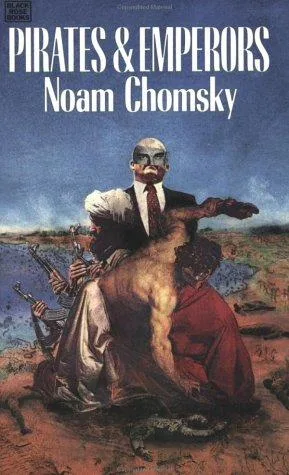
Pirates & emperors (1986)
Pirates & emperors is a 1986 history book written by Noam Chomsky.
Augustine tells of a pirate hauled before Alexander the Great and asked what he meant by keeping hostile possession of the sea. The pirate answers that he does with one small ship what Alexander does with a great fleet, and for that he is called a robber while Alexander is styled emperor. Chomsky takes the exchange as his title and as his method.
Published in 1986 as Pirates and Emperors, Old and New: International Terrorism in the Real World, the book argues that governments apply the word terrorism downward and almost never upward. Chomsky separates retail terrorism, carried out by small groups, from the state variety, carried out with air forces and budgets, then works through the record: the United States bombing of Libya, the arms deal with Iran that became a scandal in Washington, the rhetoric that surrounded both.
The other half of the argument concerns the press. Chomsky reads how reporters and broadcasters framed those events, and tracks which facts survived into public memory and which vanished. The documentation is dense and plain, assembled so a skeptical reader can check every step.
Anyone after a neutral survey of political violence should look elsewhere. This is a polemic with a thesis, written by a linguist who had already spent two decades on American foreign policy and who expects you to follow the citations. It remains one of the tightest statements of the case Chomsky would keep making for decades.
Similar books
Explore Pirates & emperors guides
A few thoughts on Pirates & emperors
Oliver Stone's Untold History of the United States walks the same postwar record on television, trading Chomsky's citations for archival footage and narration. The People Speak films Howard Zinn's companion project, actors reading letters and speeches from people written out of the official story, and it makes a warmer door into the same tradition. For the media half of the book, Fahrenheit 9/11 shows the argument staged as polemic for a mass audience, with the force and the shortcuts that implies. Charlie Wilson's War plays the covert arms pipeline to Afghanistan as a comedy of Washington charm, a useful irritant beside Chomsky's account of the same machinery. In comics, Joe Sacco's Footnotes in Gaza does on the ground the reporting this book does from the archive.