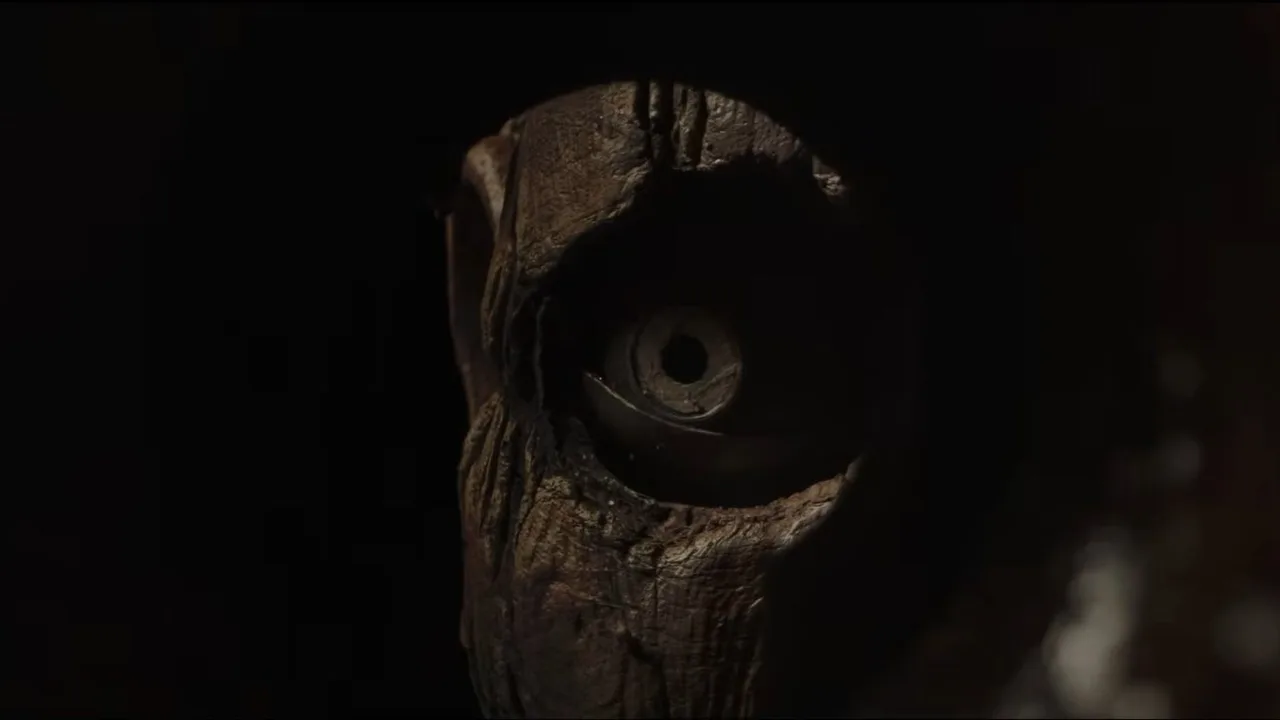
Pinocchio: Unstrung (2026)
Pinocchio: Unstrung is a 2026 horror movie directed by Rhys Frake-Waterfield, with a running time of 1h 22m. It stars Jude Evan Lloyd, Cameron Bell and Richard Brake.
A workshop, a talking cricket with bad intentions, and a wooden boy who decides that becoming real is a matter of carpentry performed on flesh. Rhys Frake-Waterfield wrote and directed this British independent slasher, the fifth entry in the Twisted Childhood Universe, the series that drags public-domain nursery characters into low-budget horror.
The frame comes from Carlo Collodi's 1883 novel [[work:le-avventure-di-pinocchio]], with the moral instruction stripped out. Geppetto builds the puppet, the cricket whispers at his ear, and Pinocchio sets out to match his brother James piece by piece. Robert Englund and Richard Brake head the cast, two faces horror audiences have followed for decades, alongside Jude Evan Lloyd, Cameron Bell, Jessica Balmer and Jack Art Gray.
Little else about the film sits on the record yet beyond that premise, the cast list and the shared universe it belongs to. Go in knowing what the TCU trades in: a familiar storybook silhouette, an unpleasant redesign of it, and a slasher structure underneath. Fans of the earlier instalments will know whether that bargain suits them.
Where to watch Pinocchio: Unstrung
Stream: Peacock Premium, Peacock Premium Plus
Rent: Amazon Video, Apple TV Store, Fandango At Home, Google Play Movies, YouTube
Buy: Amazon Video, Apple TV Store, Fandango At Home, Google Play Movies, YouTube
Cast
- Jude Evan Lloyd as Pinocchio (voice)
- Cameron Bell as James
- Richard Brake as Geppetto
- Jessica Balmer as Mia
- Jack Art Gray as Dudley
- Robert Englund as Cricket (voice)
- Emma Tate as Woodmother (voice)
- Toni Olabanji as Trey
- Luca Marandola as Logan
- Karolina Ugrenyuk as Amanda
- Mya Brown as Georgia
- Scott Chambers as Christopher Robin
Similar movies
Explore Pinocchio: Unstrung guides
A few thoughts on Pinocchio: Unstrung
The obvious companion is the book the film cannibalises. Collodi's original runs stranger and harsher than the cartoon most of us grew up on, and reading it first makes the horror version look less like vandalism. On television, Chucky is the other long-running argument that a small painted face and a knife is all a slasher needs. Don't Hug Me I'm Scared comes at the same nerve from the other side, taking the grammar of children's puppet programmes and letting it rot on screen. The Grimm Variations retells fairy tales as adult horror with far more craft, and Creepshow scratches the same practical-gore itch across short episodes. In comics, Junji Ito's Tomie is the body-horror reference point for anyone drawn to the idea of a person assembled and reassembled wrong.
The Pinocchio story from Collodi's book to the screen
Pinocchio: Unstrung keeps Collodi's frame, the workshop, the cricket at the ear, the wish to be a real boy, and throws out the moral instruction. Set the 1883 novel next to the screen versions and the edits stand out: the Disney songbook, the 1996 live-action attempt, Geppetto's side of it, even a tie-in game.
Public-domain childhood characters turned slasher villains
Rhys Frake-Waterfield builds the Twisted Childhood Universe on one move: pick a character whose copyright lapsed, hand him a weapon. Pinocchio: Unstrung is entry five, arriving after the Hundred Acre Wood films and the planned crossover. These titles share the joke, from earlier killer-puppet cheapies to television that treats nursery stories as crime scenes.
Dark fairy tales across film, comics and games
Collodi wrote a book that frightened children into behaving. Pinocchio: Unstrung drops the lesson and keeps the fright, working on the body rather than the conscience. These titles mine the same seam in other forms, taking the shapes of a child's story, the workshop, the talking animal, the storybook page, and letting them go wrong.
Low-budget horror series that keep adding entries
Pinocchio: Unstrung shot cheap, shot fast, and lands as entry five with a crossover already promised, which is how horror has grown franchises since the video-store era. Each of these kept adding chapters on the strength of one figure or one format: a masked caller, an anthology host, a woman who returns in every story Junji Ito writes.