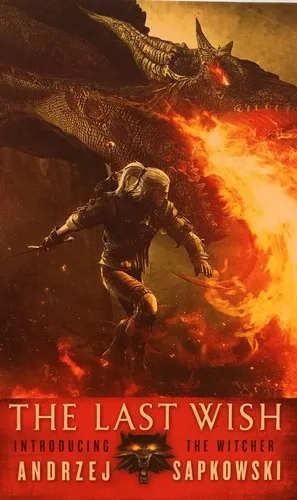
The Last Wish (2007)
The Last Wish is a 2007 Polish-language fantasy book written by Andrzej Sapkowski.
Geralt of Rivia kills monsters for money. Mutated as a boy and trained to hunt the things that prey on villages, he moves through a grim fairy-tale world where the worst creatures often walk on two legs. Sapkowski builds this first Witcher collection from linked short stories, several of them sly reworkings of familiar folk tales, framed by Geralt recovering at a temple between contracts. Here he first crosses paths with the sorceress Yennefer and the bard Dandelion. The prose runs wry, the morality stays muddy, and the swordwork matters less than the choices. A doorway into a landmark of modern fantasy.
Similar books
Explore The Last Wish guides
The Last Wish in our writing
- Companion guide: The European RPG: Gothic, The Witcher and the Continental School
- Companion guide: Grimdark: The Complete Guide to Fantasy at Its Most Brutal
A few thoughts on The Last Wish
The Witcher 3: Wild Hunt carries this world into its greatest form, the same wry, morally grey Geralt across a vast open kingdom. Readers who want their fantasy politically dirty and adult should try Game of Thrones, where charm and cruelty share every scene. The Netflix Witcher adapts these very stories.
Dark medieval RPGs about hunting monsters for coin
Geralt takes contracts to kill monsters for money, and more often than not the real monster turns out to wear a human face. The Witcher 3, the original Witcher and its sequel put you directly in his boots, while Kingdom Come: Deliverance and Gothic share the same grounded, morally murky medieval world where survival matters more than heroics.
Wandering warriors across ruined, monster-filled worlds
The Last Wish sends Geralt from village to village, taking whatever grim contract the road offers next. Elden Ring's Tarnished, Skyrim's wandering outsider, Kratos in God of War, Link across Hyrule, and Hollow Knight's silent traveler all cover similar ground: a lone fighter crossing a broken world, killing what needs killing, one region at a time.
Grim, morally gray fantasy worlds on screen
The Last Wish never lets its monsters or its humans off easy, and that same moral murk runs through its own adaptation, The Witcher, plus Game of Thrones and House of the Dragon's court politics, The Boys' bloody satire of who the real villains are, and Excalibur's ruthless take on Arthurian myth. None of them offer a clean hero.
Dark, atmospheric music for the road between contracts
Sapkowski's stories move at a slow, brooding pace between violence, the kind of mood these albums share. King Crimson's In the Court of the Crimson King and Equilibrium's folk-metal atmosphere both lean into old, half-remembered myth, while Judas Priest's Painkiller and Fates Warning's The Spectre Within bring the same restless intensity as a contract gone wrong. The Return of the King's score closes on the same epic, orchestral register.