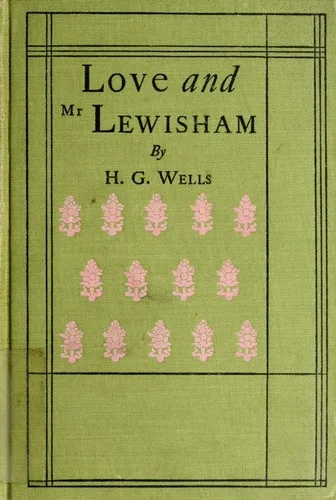
Love and Mr. Lewisham (1899)
Love and Mr. Lewisham is a 1899 classic literature book written by H. G. Wells.
Wells set the scientific romances aside for this one. He called the writing an altogether more serious undertaking than anything he had done before, and the result is a Victorian novel with no Martians in it.
Mr Lewisham starts out with youthful hopes of fame and glory and trades them for love. He moves to London, talks himself into the merits of socialism, and gets drawn into the spiritual charlatanism that did brisk business in the later Victorian years. Wells placed the story in the 1880s and published it in 1900, early in a turn toward ordinary lives that most readers still do not associate with him.
He took considerable pains over the manuscript and stayed fond of the book: in 1933 he gathered it into his anthology Stories of Men and Women in Love. Anyone arriving here expecting an invasion or a time machine gets London, socialism and a clever young man reasoning himself into trouble.
Read it for the comedy of self-deception, for a close look at what ambition costs once love complicates it, and for Wells writing without a single impossible machine to lean on.
Similar books
A few thoughts on Love and Mr. Lewisham
The bind here, a poor young man choosing between the future he planned and the person he wants, travels well across media. Martin Eden pulls the same wire tighter: Jack London's self-taught striver reads his way into socialism and into a love he cannot square with it, and the film keeps the argument as sharp as the romance. Daniel Deronda gives you George Eliot on marriage as an economic decision, which is the calculation Lewisham keeps trying to dodge. The Paradise sets a shop girl's ambition against a commercial London that rewards it unevenly, close in period and in class detail. Bright Young Things jumps forward forty years to a couple postponing a wedding they cannot fund, the same problem in a faster, funnier register.
If you only know H.G. Wells for the Martians
Wells wrote this while the scientific romances were making his name, and it contains no Martians, no time machine, and no invisible men. Start with the realist novel, then take the rest of his shelf: the short stories, the screen versions of the big ideas, and the stories other writers built around Wells himself.
Young strivers who trade the plan for love
Lewisham pins a schedule of study and glory above his desk at eighteen, moves to London on it, then trades the whole plan for Ethel. Martin Eden, Paul Morel and the rest climb the same ladder of self-education and meet somebody halfway up. Each author weighs a career against a marriage and refuses to make the sum come out clean.
Victorian seances, mediums and the money behind them
Wells drops Lewisham into the seance trade, where the man rapping the table defends his fraud as honest work and makes a decent living at it. Late-Victorian London ran a brisk market in the supernatural. These stories pick at the same fringe: a cursed book, a house with ghosts, a doctor with a second self, a count with a shipping schedule.
Period drama that counts the cost of a marriage
Lewisham's romance runs on arithmetic: lodgings in London, a junior teacher's pay, a wedding he cannot really afford. These films and series keep the ledger in frame too, in drapery shops, cotton mills and department stores where courtship happens between shifts. Same decades, same pressure, better clothes.