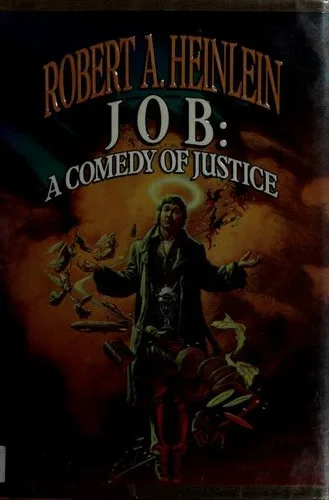
Job, a comedy of justice (1795)
Job, a comedy of justice is a 1795 american science fiction book written by Robert A. Heinlein.
Alexander Hergensheimer, a straitlaced Kansas minister, walks across hot coals at a Polynesian resort and comes back to a world subtly wrong. His ship has changed, strangers call him Alec Graham, and the fellow passenger he falls for, a Danish stewardess named Margrethe, becomes his one fixed point as reality reshuffles around them without warning. Robert Heinlein sends the pair tumbling between alternate Earths, each shift stripping away money, certainty, and sometimes clothes, while his hero clings to a faith that keeps getting the joke played on it. The tone is puckish, the target is piety, and the machinery running the universe has a cruel sense of humor.
Similar books
Explore Job, a comedy of justice guides
A few thoughts on Job, a comedy of justice
For the same comic theology, Good Omens plays an angel and a demon off each other as the apocalypse bumbles forward, sharing this book's affection for believers caught in a cosmic prank. The Adjustment Bureau offers the paranoia of unseen powers rewriting a life, and The Matrix answers the deeper worry that the world you trust is a set someone else controls.
Ordinary lives secretly steered by forces behind the curtain
Heinlein sends Alec tumbling between alternate Earths that look almost right until they don't, and that same vertigo runs through The Matrix and The Adjustment Bureau, where ordinary men discover their whole life was arranged by someone else. Good Omens plays the same con for laughs with angels and demons pulling strings, while Muse's Simulation Theory and Black Holes and Revelations turn the same paranoia into arena rock.
Video games where an unseen authority keeps testing you and moving the goalposts
Job keeps landing in worlds nearly identical to his own, run by a power testing how far he'll bend before he breaks. Portal and Portal 2 trap you the same way, an unseen voice grading your every step, and BioShock's puppeteer strings and BioShock Infinite's dimension-hopping tears do the same trick with a god complex. Half-Life 2's G-Man watches Gordon the same silent way.
Stories where the people in charge are only pretending to be gods
The joke in Heinlein's title is that Job's God might just be a bureaucrat with poor customer service, and Stargate SG-1 makes the same case literally, with aliens posing as pharaohs and gods to rule the credulous. The Handmaid's Tale shows a whole regime built on the same borrowed authority, The Boys does it with worshipped superheroes, and Silo hides its false shepherds behind a locked door.