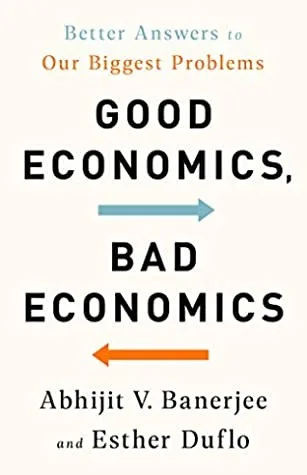
Good Economics for Hard Times (2019)
Good Economics for Hard Times is a 2019 economics book written by Abhijit Banerjee and Esther Duflo.
Two Nobel-winning economists sit down with the arguments that dominate dinner tables and election campaigns, then check them against evidence. Abhijit Banerjee and Esther Duflo, both at MIT, take on immigration, trade, inequality, automation and the stalling of growth, and they are candid about where the profession has been wrong. Their method favors careful field experiments over ideology, so the answers rarely flatter either political side. The prose stays plain and patient, built for readers who want to understand policy rather than win a fight. A sober, humane guide to problems that resist easy slogans.
Similar books
A few thoughts on Good Economics for Hard Times
Readers drawn to clear-eyed economics on screen can try Inside Job, Charles Ferguson's documentary anatomy of the 2008 crash, or The Big Short, which turns the same collapse into sharp black comedy. Both share this book's instinct for testing confident claims against what actually happened to ordinary households rather than to the models on a whiteboard.
If you want the financial crisis on screen instead of on the page
Good Economics for Hard Times returns often to the 2008 crash and the distrust it left behind. These films cover that ground with faces and timelines instead of data. Inside Job tracks the bankers and the academics who signed off on the risk, The Big Short follows the few who bet against it, and Too Big to Fail sits in the room during the bailout.
Books arguing over what capitalism owes people
Banerjee and Duflo argue that growth has stalled in rich countries and that policy on trade, migration and taxes should answer to evidence rather than doctrine. The books here take up those questions and land somewhere else, from the case for rebuilding the welfare state to Mill's older account of how wealth gets shared out. Read them for the counterarguments.
Shows that take a policy argument apart on air
Banerjee and Duflo open with the arguments people have at dinner tables and in election campaigns. These shows run on the same fuel. A host takes one policy, puts the numbers on screen, states the opposing case in full and then answers it. The format gives you the book's patience about evidence in the length of a segment.