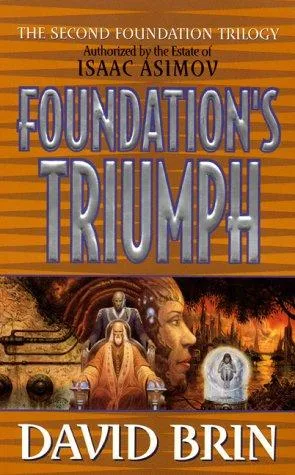
Foundation's Triumph (1999)
Foundation's Triumph is a 1999 fiction book written by David Brin.
David Brin drew the final volume of a relay Isaac Asimov never lived to finish, and he treated the job as a continuity problem worth solving. Foundation's Triumph closes the Second Foundation Trilogy, the three-book sequence the Asimov estate authorized after his death, following Gregory Benford's Foundation's Fear and Greg Bear's Foundation and Chaos.
Brin returns to Hari Seldon in old age, decades past the work that made him famous, and puts him back in motion across an Empire already sliding toward the dark age his own mathematics predicted.
Reconciliation is the real project. Asimov spent his later career stitching the Robot novels to the Empire novels to the Foundation books, and the seams stayed visible. Brin treats those seams as material, pulling the robots, the Empire and the Foundation into one argument about what humanity should be allowed to become. He draws on dozens of Asimov's novels and stories, plus Roger MacBride Allen's authorized entries, and forces the lot into a single consistent frame. An appendix chronology compiled by Attila Torkos lays the timeline out for anyone who wants to audit the result.
This one is written for readers who already own the shelf. Arrive with Foundation and a few of the robot novels behind you and Brin's argument lands. Arrive cold and it reads as a puzzle box missing half its pieces.
Similar books
Explore Foundation's Triumph guides
Foundation's Triumph in our writing
- Companion guide: Foundation: The Complete Guide to Isaac Asimov's Galactic Empire
A few thoughts on Foundation's Triumph
The 2021 series Foundation rebuilds the same universe with a different temperament, heavy on dynastic spectacle where Brin is busy reconciling a bookshelf, and the contrast tells you a lot about both. 3 Body Problem carries the other half of the appeal, a civilization doing arithmetic on a timescale no single person survives. Dune hands you an empire decaying on schedule and a man who can see the shape of the fall. For the robot end of Asimov's shelf, Mass Effect 2 drops you into a galaxy that keeps rediscovering the same extinction and lets you argue with synthetics about who counts as a person. Two comics finish the run: Logicomix, which follows real mathematicians chasing a complete formal system, and Tezuka's Phoenix, which runs whole civilizations up and down across millennia.