Fist of the North Star (1983)
Fist of the North Star is a 1983 science fiction anime and manga title by Buronson and Tetsuo Hara.
The nuclear war has already happened. The desert left behind belongs to gangs, bandits and warlords, and one man walks into their territory alone.
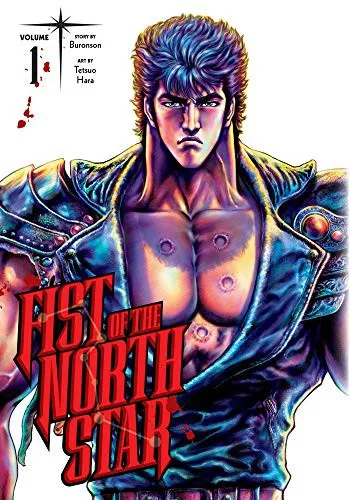
Buronson wrote it, Tetsuo Hara drew it, and the drawing is half of why it still lands. Hara works in heavy ink and enormous physiques, holds a face in close-up for most of a page, and lets a single strike fill a spread. Kenshiro carries the succession of Hokuto Shinken, an assassination art that works on the body's vital points rather than on force, which is how the series earned its reputation for gore. Opponents come apart. The panel that follows a hit is the whole appeal.
The shape suits weekly serialisation. Kenshiro crosses ruined ground, finds a settlement being bled by a gang or a warlord or a rival martial artist, and settles the account, then moves on. Shueisha ran it in Weekly Shonen Jump for 245 issues between 1983 and 1988, collected into 27 tankobon volumes under the Jump Comics imprint.
For all the pulped anatomy, the premise is protective: the people Kenshiro fights for are the ones with nothing. Read it for the operatic scale, the stark desert panels, and a lead who says very little and means all of it. Plenty of later action manga borrowed the template.
Official site
Similar titles
Explore Fist of the North Star guides
Fist of the North Star in our writing
- Companion guide: Battle Shonen: The Complete Guide to Fighting Anime
A few thoughts on Fist of the North Star
Battle Angel Alita, Volume 1 is the closest match on the shelf: another ruined world, another fighter rebuilt for combat, and art that treats the human body as the main event. For similar brutality in a different register, Berserk, Vol. 17 swaps the wasteland for a black medieval Europe and Hara's clean heavy ink for dense crosshatching, with the same lone swordsman standing between a monster and the people it feeds on. Prose readers should take Swan Song, a long post-nuclear American novel that follows survivors instead of warriors and gives the empty highways and wrecked towns the room a weekly serial never has. The anime and films cover the same story rather than extending it, so start with the volumes.
Post-apocalyptic wastelands after the nuclear war
Fist of the North Star opens after the bombs, in a desert run by gangs and warlords, and Kenshiro crosses it on foot with no vehicle and no allies. These share that geography: scarce water, roving crews, small settlements paying protection. Swan Song works the same nuclear ground in prose, and Battle Angel Alita builds a city out of the leftovers.
If you want the anime and the games after the manga
Buronson and Hara serialized Fist of the North Star from 1983, and the adaptations arrived fast. The 1984 TV anime tracks the manga arc by arc, the 1986 film compresses the opening into one theatrical cut, Ken's Rage turns Hokuto Shinken into a Musou brawler, and Fist of the Blue Sky moves the same school back to 1930s Shanghai.
Manga where the art hits as hard as the fights
Tetsuo Hara draws Fist of the North Star in heavy ink: enormous physiques, a face held in close-up for most of a page, one strike filling a spread. These artists work at the same weight. Goseki Kojima stages Lone Wolf and Cub with the same patience before a cut, and Kentaro Miura loads the Berserk pages with the same density of black.
Shonen action built on a one-strike finish
Hokuto Shinken ends a fight on contact, so Fist of the North Star puts its tension in the seconds before the blow rather than in the exchange. Each of these answers that problem another way: Dragon Ball escalates power levels, Saint Seiya ranks its armor, Rurouni Kenshin hands its swordsman a reversed blade, and One-Punch Man turns the instant finish into the joke.