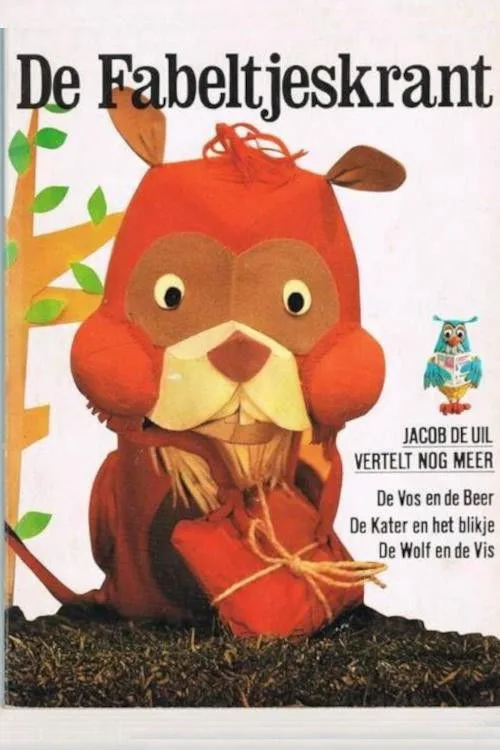
The Daily Fable (1968)
Original title: De Fabeltjeskrant
The Daily Fable is a 1968 Dutch-language kids series created by Thijs Chanowski and Leen Valkenier. It stars Frans van Dusschoten, Ger Smit and Elsje Scherjon.
Every evening an owl in a tree opens the newspaper and reads the day's news aloud to the forest. Dutch children sat through that ritual for twenty-one years.
De Fabeltjeskrant arrived in 1968, built by the writer Leen Valkenier with producers Thijs Chanowski and Loek de Levita out of hand-made puppets and patient stop-motion. Meneer de Uil delivers the headlines from het Grote Dierenbos, and the story behind them plays out among the animals who made it. Bor de Wolf grumbles. Zoef de Haas talks at top speed. Lowieke de Vos angles for advantage, Ed en Willem Bever agree with each other about everything, and Juffrouw Ooievaar keeps her opinions in public view. Quarrels start over small things, and somebody apologises before bedtime.
Valkenier wrote for the grown-ups in the room as well. The forest ran on the manners, the gossip and the small politics of the country watching it, in rhyme, in five minutes, with a moral light enough to swallow. Three actors carried nearly the whole cast between them: Ger Smit as Meneer de Uil, with Frans van Dusschoten and Elsje Scherjon voicing the rest of the animals.
NOS broadcast it until 1989. VRT carried it in Belgium, NHK in Japan, and ITV ran it in Britain from 1973 to 1975 under the title The Daily Fable. RTL 4 and RTL 8 brought it back for later Dutch generations. Nothing about it hurries. A small, well-mannered world puts its lights out at the same hour every night, and a newcomer can start anywhere.
Official site
Cast
Similar series
Explore The Daily Fable guides
A few thoughts on The Daily Fable
Start with The Smurfs. Peyo built a village where each resident is one trait taken to its limit, the same engine that keeps Bor de Wolf and Lowieke de Vos funny for two decades, and the jokes about how a small community governs itself land in the same register.
Winnie the Pooh and the Honey Tree is the closest match on film: a forest of animals with fixed temperaments, stakes no bigger than a jar of honey, a narrator holding the whole thing together.
For the craft, Tales from the Magic Garden shows what European stop-motion puppetry looks like now, handmade and unhurried.
On the page, Spike and Suzy is the Flemish family comic that sat in the same living rooms, and Tonke Dragt's De brief voor de koning comes off the same Dutch childhood shelf, written for children who can be trusted with consequence.
Shows set in one small animal town where everyone knows everyone
De Fabeltjeskrant keeps its whole cast inside one wood, so Bor de Wolf and Lowieke de Vos turn up in each other's stories night after night. These shows work the same way: a fixed set of animal neighbours, a few houses, and plots that come out of who lives next to whom rather than anything outside the forest.
Fables with animal casts, from Aesop to modern comics
Meneer de Uil reads the day's news out of his paper and the animals act out the moral underneath it, the old Aesop bargain in Dutch fur. These take the same deal: animals stand in for human habits, the story stays short, and the point lands without a sermon. Comics, film and television, Aesop through to a modern fable anthology.
Hand-made children's animation from before computers
Chanowski and de Levita carved the Fabeltjeskrant puppets and shot them a frame at a time, and the fingerprints show on screen. These share the method: fur, felt, cardboard and glass moved by hand and shot on film, decades before a computer could fake the texture. Most came out of small European studios working at that same scale.
Kids' shows built on a nightly ritual
De Fabeltjeskrant ran on the clock: an owl opened his newspaper at the same hour each evening and Dutch children sat down for it. These run on the same fixed ritual, a host or a framing device that returns every episode, one short story inside it, and an ending calm enough to send a child to bed.