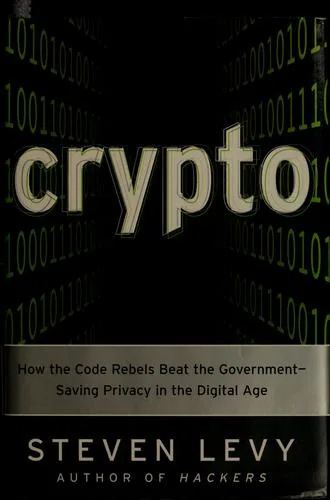
Crypto (2001)
Crypto is a 2001 geheimschrift book written by Steven Levy.
Strong encryption was government property for most of the twentieth century. Steven Levy tells the story of the mathematicians, graduate students and activists who pulled it into public hands, and of the National Security Agency that spent two decades trying to keep the lid on.
The book moves through the turning points in order. Public key cryptography arrives first, the idea that two strangers can agree on a secret over a line anyone can listen to. RSA turns that idea into a working algorithm and then into a business. Digital signatures follow, and with them the question of what a signature even means when nothing is written by hand. Alongside the inventions sits the politics: the Data Encryption Standard, whose key length the agency helped set, and the Clipper chip proposal of the 1990s, which brought the argument between federal wiretap policy and the cypherpunks into open view.
Levy writes people, not proofs. Anyone after the mathematics will need a textbook instead. Anyone who wants to know who argued what, in which room, and what it cost them, is the reader he has in mind.
One caution on the title: this is cryptography, not cryptocurrency. Published in 2001, the book stops well before the surveillance fights of the following decade, which makes it the origin story rather than a report on the present.
Explore Crypto guides
A few thoughts on Crypto
Sneakers is the closest companion in any medium, a 1992 caper built around a box that breaks codes, with politics lifted from the same standoff Levy reports. Horizon: Defeating the Hackers covers the engineering in documentary form and shows the attacks these systems were designed to survive. Logicomix tells a comparable story a generation earlier, logicians chasing certainty at real personal cost, and the art carries the abstraction better than prose does. Exapunks puts you on the other side of the keyboard, writing the code instead of reading about it. For the culture that grew out of all this, Mr. Robot, and for coders taking an institution to court, The Billion Dollar Code.
Nonfiction about who gets to read your messages
Levy's subject in Crypto is a twenty year fight over whether ordinary people may hold keys the government cannot open: export rules, the Clipper chip, the NSA, Phil Zimmermann's legal trouble over PGP. These carry the same argument forward into data brokers, breaches and the surveillance wired into services you already use.
Fiction built on real cryptography
Crypto lays out public key exchange, RSA and digital signatures in plain prose, so the tradecraft in these lands with more weight afterwards. Stephenson worked the same history Levy documents, Enigma sits inside Bletchley Park, and Sneakers turns a codebreaking box into a heist. Read the nonfiction first and the fiction stops feeling like a hand-wave.
Hacker culture before the money arrived
Levy wrote Hackers before Crypto, and the same cast carries over: graduate students, cypherpunks and hobbyists who treated a locked system as an invitation. Crypto follows that crowd into cryptography and into court. These cover the wider culture, from mailing lists and phone phreaking to the point where venture capital showed up.
Popular science that explains the hard part properly
Levy builds Crypto out of interviews with Diffie, Hellman, Rivest and the people around them, so the mathematics arrives through the arguments they had rather than as a lecture. These do the same job on other subjects, taking a proof, a cosmology or a security problem and showing the wrong turns before the answer.