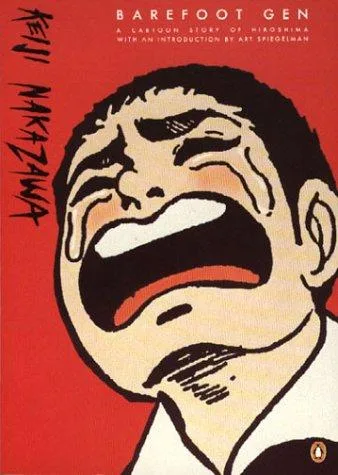
Barefoot Gen (1973)
Barefoot Gen is a 1973 drama anime and manga title by Keiji Nakazawa.
Hiroshima, 1945. Six-year-old Gen Nakaoka lives with his family in a city still holding to its routines, rationing, school, arguments at home, up to the morning the bomb falls on it. The series stays with Gen and the other survivors after that, in the ruins, among people looking for food, for shelter, for a way to keep going.
[[person:keiji-nakazawa]] wrote and drew it. He was a child in Hiroshima when the city was bombed, and he lived through it; Gen's story is based loosely on his own. He works at ground level, with one family and one neighbourhood, and leaves the larger conclusions to the reader.
The serialization ran from 1973 to 1987 across several Japanese magazines, including Weekly Shonen Jump. It has been filmed more than once since: three live-action features directed by Tengo Yamada between 1976 and 1980, two animated films from Madhouse in 1983 and 1986, and a two-night live-action drama on Fuji TV in August 2007.
Read it for the record it keeps. Nakazawa sets down what happened to his city and to the people in it, without working the material for effect.
Similar titles
Explore Barefoot Gen guides
A few thoughts on Barefoot Gen
The 1983 Madhouse film Barefoot Gen animates the opening stretch and is the shortest route into the same material; the 1986 sequel Barefoot Gen 2 carries it into the years after. Tengo Yamada's live-action version from 1976 predates both.
For film made close to the event, Children of Hiroshima (1952) and Hiroshima (1953) were both shot within a decade of the bombing. In print, Town of Evening Calm, Country of Cherry Blossoms stays with Hiroshima families long after 1945, and Sadako and the Thousand Paper Cranes tells a survivor's story at a child's scale. Prompt and utter destruction covers the decision from Washington's side, which Nakazawa never sets out to explain.