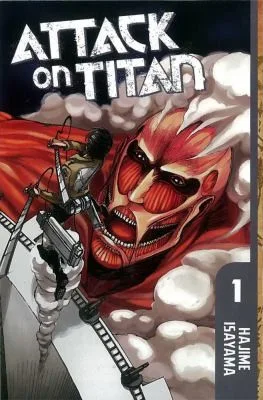
Attack on Titan (2009)
Attack on Titan is a 2009 adventure anime and manga title by Hajime Isayama.
Humanity has spent generations inside three enormous walls and stopped asking what the arrangement costs. Outside stand the Titans: huge, humanoid, man-eating, and silent about their reasons. Hajime Isayama opens Attack on Titan at the moment the walls stop working. Eren Yeager, a boy from a town in the outer ring, watches his home come apart and swears to exterminate every Titan alive, which is less a plan than a wound he carries into the military.
Isayama wrote and drew the whole run himself, serializing it in Kodansha's Bessatsu Shōnen Magazine from September 2009 to April 2021. The monthly schedule bought him longer chapters than a weekly title allows, and the 34 collected tankōbon volumes hold one continuous story with a fixed destination, so the early volumes read differently once you know the series has somewhere specific to go. His art is blunt and unglamorous, closer to war reportage than to polished shonen action, and the Titans carry a flat, grinning wrongness that does more work than any amount of gore.
Every genre label stuck to it applies at once: dark fantasy, survival, post-apocalyptic, dystopian. Read it if you want an adventure manga that treats its own premise as a question worth chasing, and that never lets a victory stay clean.
Official site
Similar titles
Explore Attack on Titan guides
Attack on Titan in our writing
- Companion guide: Battle Shonen: The Complete Guide to Fighting Anime
- Companion guide: Grimdark: The Complete Guide to Fantasy at Its Most Brutal
A few thoughts on Attack on Titan
If the walls are what hooked you, The Last of Us runs on the same logic: fortified quarantine zones, a civilian population managed like livestock, and a teenager whose survival matters more to the adults around her than they will say out loud. It trades Isayama's scale for intimacy and keeps the dread intact.
For the war half, Mobile Suit Zeta Gundam puts conscripted teenagers in machines nobody should trust them with and refuses to hand either faction a clean conscience. It aired in 1985 and it still stings.
On the page, Chainsaw Man, Vol. 7 is the closest modern descendant of Isayama's appetite for ugly, fast, unsentimental action, with monsters whose design logic runs to the absurd instead of the majestic.