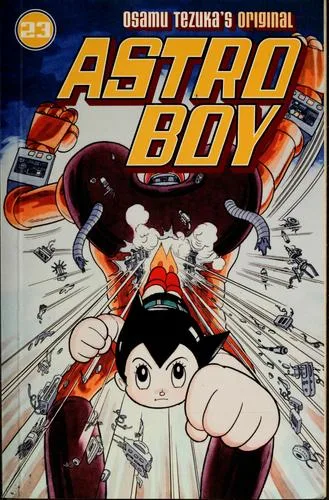
Astro Boy (1952)
Astro Boy is a 1952 action anime and manga title by Osamu Tezuka.
A grieving scientist builds a robot in the shape of the son he lost, then sells the machine to a circus. Osamu Tezuka opened his most famous serial on that cruelty in 1952 and spent the next sixteen years working out what the discarded boy owed the world that made him.
Astro Boy, published in Japan as Mighty Atom, follows an android child with human feelings, built by the scientist Umataro Tenma in the likeness of his son Tobio. Astro passes through a robot circus run by the showman Hamegg before Professor Ochanomizu takes him in, gives him a robot family, and tries to let him have something close to an ordinary boyhood between rescues.
Tezuka draws Astro small, round and wide-eyed, a cartoon child moving through a world of adults with laboratories and agendas. The gentle line does heavy work: it lets a children's adventure carry arguments about machine rights, prejudice, and what an inventor owes the thing he invented. The serial ran in Kobunsha's Shonen from 1952 to 1968, 112 chapters, collected into 23 tankobon volumes by Akita Shoten. Dark Horse Comics published the English translation in 2002.
Rocket flight, super strength and robot brawls carry the adventures, but Tezuka keeps circling the same sore spot. Astro can do almost anything, and still has to argue for the right to be treated as a person.
Official site
Similar titles
Explore Astro Boy guides
A few thoughts on Astro Boy
Naoki Urasawa's Pluto, Vol. 2 is the obvious next stop, a retelling of Tezuka's most famous robot story as a detective case, drawn with heavy photographic realism in place of cartoon roundness. Atom. The Beginning Vol. 1 runs the other way, following the two young engineers who build the prototype behind Astro, and the 2017 anime version keeps the same lab-bench mood. For Tezuka at full stretch, try Phoenix and his Buddha, the same soft line applied to centuries of history. On a console, Astro Boy: Omega Factor is Treasure's fast, dense Game Boy Advance action game, stuffed with characters from across Tezuka's catalogue. Tetsujin 28 covers the other great 1950s robot serial, and Geinoh Yamashirogumi's Symphonic Suite AKIRA gives this whole lineage of Japanese science fiction its sound.