A people's tragedy (1996)
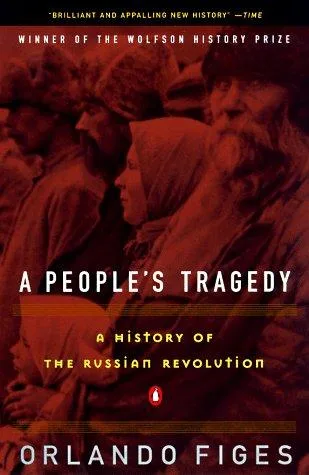
A people's tragedy is a 1996 history book written by Orlando Figes.
Orlando Figes tells the Russian Revolution as a human catastrophe. Covering the years from 1891 to 1924, the British historian moves between the sweep of war and upheaval and the private lives caught inside it: the patriotic general Brusilov, the peasant Semenov, the writer Maxim Gorky. Figes argues that peasants, workers and soldiers were not simply victims of the Bolsheviks but participants in their own unraveling, and that the failure of democracy in 1917 was rooted deep in the old order. The result is history told at epic and intimate scale at once.
Similar books
Explore A people's tragedy guides
A few thoughts on A people's tragedy
Orlando Figes reads like tragedy, so the screen companions that fit best keep the human cost in frame. Reds dramatizes these same years through witnesses who believed in the cause, and Doctor Zhivago follows love and survival as the country comes apart. Both trade the textbook for faces.
Historical dramas that follow one life through world-shaking events
Figes builds A People's Tragedy by moving between the fall of an empire and the private terror of a general, a peasant, a writer inside it. These titles use the same trick, compressing a revolution, an atomic weapons program or a global war into a single recognizable life, so vast history reads as something a person actually endures rather than a date on a timeline.
Peasants and soldiers caught when the old order breaks apart
The book's argument is that ordinary people were not just swept along by 1917, they helped bring the old order down. These series put that same pressure on working families and foot soldiers: loyalty tested, class resentment simmering, empires or clans cracking under their own weight while the people at the bottom decide which way to jump.
History you can walk through instead of just read about
Figes reconstructs the revolution scene by scene, from the general's headquarters to the peasant's hut, until the collapse of an empire feels close enough to touch. These games do something similar with other turning points, dropping you into Renaissance Italy, the Caribbean slave trade or the American Revolution as a participant rather than a spectator, with the same appetite for lived-in, specific historical detail.